

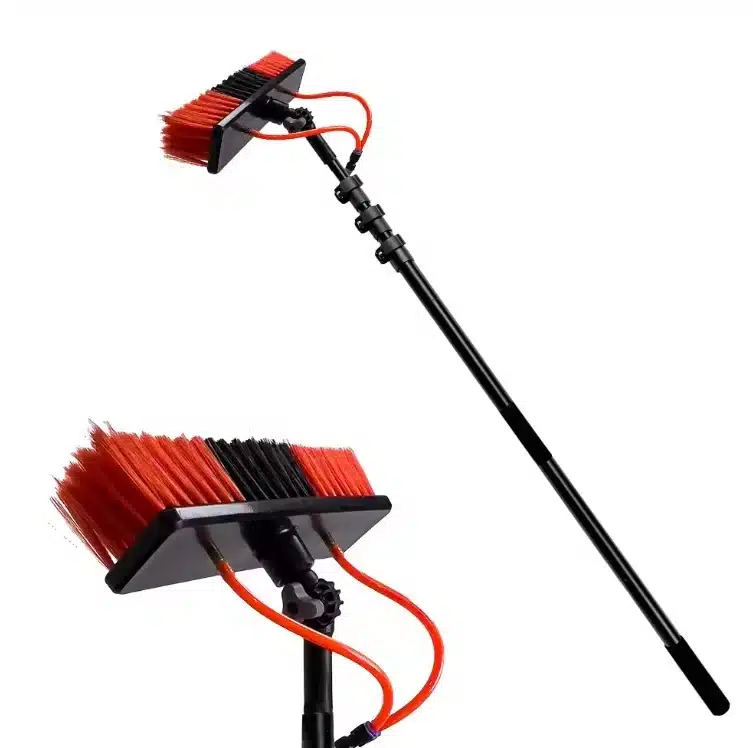
A window cleaning pole for conservatory roof use isn’t something most people think about until they’re staring up at a streaky, grimy roof and wondering how to tackle it safely. The good news: you don’t need a ladder, a scaffold tower, or a professional contractor. The right telescopic pole, set up correctly, lets you clean conservatory glass thoroughly from the ground.
Most poles sold on general marketplaces aren’t designed with conservatory geometry in mind. This guide covers what actually matters: the right reach, the right brush angle, and whether a water fed setup is worth it for your situation.
Why a Standard Window Cleaning Pole Won’t Cut It on a Conservatory Roof
Conservatory roofs present a specific set of challenges that catch people out with a generic pole.
First, the pitch is low, typically between 15° and 25° on a UK Victorian-style or lean-to conservatory. That shallow angle means a flat brush head skims across the glazing bars rather than pressing into the glass surface. You end up pushing dirt along the glazing bar edges instead of lifting it off the pane.
Second, the glazing bars run in a grid pattern. If your brush is the wrong width or shape, you’re constantly catching bar edges, losing contact with the glass, and leaving dirty lines where each bar sits.
Third, conservatory glass, whether polycarbonate or toughened glass, tends to show streaks badly in direct light. A dry wipe with a standard flat pad and no rinsing just redistributes the grime.
The result with the wrong pole: streaks, residue in every bar channel, and a roof that looks almost as bad after cleaning as before. The fix is choosing a pole designed for the reach, angle, and flow control this job actually needs.
How to Choose the Right Window Cleaning Pole for a Conservatory Roof
Getting the Reach Right: Pole Length for Conservatory Glass
Most standard lean-to conservatories in UK terraced and semi-detached homes have a roof ridge height of roughly 2.5–3.5 m. A telescopic window cleaning pole with brush with a working reach of 4–6 m covers this comfortably from the ground, the extra length above ridge height accounts for angle and overlap when working across the slope.
Larger Victorian or Edwardian conservatories with hipped roofs can sit higher. For those, aim for a pole with a maximum extended length of at least 6 m.
The key word is working reach. A pole advertised at 6 m often means 6 m fully extended, which is unwieldy and weakens tip rigidity. Choose a pole where you’re using 4–5 m of extension comfortably, not straining at the absolute limit.
Angled Brush vs. Flat Brush: Which Works Best on a Sloped Roof?
For conservatory glass, an angled or fan brush outperforms a flat pad every time.
On a low-pitch roof, you’re pushing the pole up and away from you at a steep upward angle. A flat brush head sits parallel to the pole shaft, so it contacts the glass at a skewed angle, one edge digs in, the other lifts off. An angled brush head is offset, so when the pole is at a natural working angle, the bristles sit flat against the glass.
Fan-style brush heads distribute bristle contact even further, which helps when you’re bridging a glazing bar. They’re the standard choice among professional window cleaners working conservatory glass for exactly this reason.
Water Fed Pole for Conservatory Cleaning: Is It Worth It?
For most conservatory owners, yes, a water fed pole setup delivers a noticeably better result than a dry pole.
Here’s how it works: purified water (zero dissolved solids) is fed through the pole shaft and out through the brush head as you scrub. Because the water carries no minerals, it dries without leaving spots or streaks. No squeegee pass needed, which matters enormously on a roof you can’t reach by hand.
Dry poles are a cheaper entry point, and they work for a quick rinse-and-brush if the roof isn’t heavily soiled. But without purified water, you’re relying on the glass drying quickly and evenly. On a conservatory roof, which catches wind, shade, and debris differently across its surface, that rarely happens consistently.
Purified water fed through a brush head dries without spotting, which removes the need for a squeegee pass that would otherwise require ladder access. That’s the core advantage.
A water fed pole system guide for UK homeowners covers the full setup in detail, including water filter options and hose connections. A basic water fed kit for home use is more affordable in 2026 than most people expect, and the hose connection doubles up for other tasks like solar panel cleaning or garden-side window work.
For a direct look at how the two methods compare, the water fed pole vs traditional window cleaning breakdown is worth reading before you buy.
How to Clean a Conservatory Roof Without a Ladder: Step-by-Step
Cleaning a conservatory roof without a ladder is straightforward once the pole is set up correctly. Work in sections, most conservatories break naturally into pane rows.
Step 1, Pre-rinse. If you’re using a water fed setup, run water through the brush and do a light pass across the whole roof. This loosens surface dirt and algae before scrubbing.
Step 2, Scrub each pane in overlapping strokes. Work from the ridge downward, using side-to-side strokes that overlap by about a third of the brush width. Follow the line of each pane rather than fighting across the glazing bars.
Step 3, Work along the glazing bars. Run the brush along each bar channel to dislodge debris that’s settled in the groove. This is where most of the visible grime accumulates on older conservatories.
Step 4, Final rinse from ridge to eave. With a water fed pole, do a final slow rinse pass from the top down, letting purified water push any remaining residue toward the gutters.
If you’re using a dry pole, finish with a microfibre rinse attachment if you have one, or accept that a second pass in a few hours (once the glass dries) may be needed to catch any residue.
Safety Tips Before You Start
Cleaning a conservatory roof without a ladder is significantly safer than working at height, but ground-level pole work still has risks.
- Watch the wet floor. Water runs off the roof quickly and pools on patios. Non-slip footwear is essential, and keep anyone else clear of the run-off zone.
- Don’t over-extend the pole. Pushing the pole to its absolute limit reduces tip control and increases the risk of snapping a section lock. Work at a comfortable extended length and move your standing position instead.
- Stand to the side, not directly below. Working at an angle gives you better leverage and means falling debris, dislodged moss, leaves, grit, doesn’t land on you.
- Check the pole sections before each use. Worn twist-lock sections can slip under load. A pole that collapses mid-stroke on a wet patio is a trip hazard.
The how to clean upstairs windows without a ladder guide covers the broader safety case for ground-level pole work, relevant if your conservatory adjoins a two-storey extension.
Working at height on a fragile or wet surface is the single biggest injury risk in domestic window cleaning. A ground-level pole setup removes that risk entirely.
Telescopic Pole for Conservatory: What to Look for in 2026
There’s no shortage of cheap telescopic poles on the UK market. Most are fine for reaching a first-floor window with a flat brush. For conservatory roof work, the spec requirements are tighter.
Section locks. Twist-lock sections are lighter and simpler. Clamp-lock (lever clamp) sections hold their position more reliably under lateral load, useful when you’re pushing against the resistance of a scrubbing brush at full extension. For conservatory work, clamp-lock sections on the upper joints are worth the marginal extra weight.
Carbon fibre vs. fibreglass. Carbon fibre poles are lighter, stiffer, and noticeably easier to control at full extension. Fibreglass poles cost less and are perfectly functional, but at 5–6 m extended, the flex in a fibreglass pole makes precise brush placement harder. If budget allows, carbon fibre is the better choice for roof work.
Brush fitting compatibility. Make sure the pole accepts standard brush fittings, most UK-spec poles use a standard thread or clip that’s compatible with fan and angled brush heads. Non-standard fittings lock you into one brand’s accessories. Browse water fed pole accessories to check what’s compatible before committing.
Price point. A capable fibreglass telescopic pole for conservatory use starts at around £30–£60. A carbon fibre equivalent with water fed capability sits in the £80–£150 range for home use. Paying more than that for a domestic setup rarely adds practical value.
Paul’s Poles supplies water fed pole systems used by both UK homeowners and professional window cleaners. The products are specced for real-world domestic conservatory use, not just priced for the marketplace and left without after-sales support.
If you’re also thinking about cleaning roof-mounted solar panels from the ground, the same pole setup works there too.
Ready to Clean Your Conservatory Roof from the Ground?
The right window cleaning pole for conservatory roof work makes the whole job straightforward: no ladder, no contractor, no streaky glass. Get the reach right, use an angled brush, and add purified water for a spot-free finish.
Browse Paul’s Poles’ range of telescopic poles and water fed systems, built for exactly this kind of job, at a price that makes sense for a home setup.
A little advice. The right pole.
Find a kit that suits your home, or ask Paul for help with your next clean.
